 Stephen Sumner
The Function Is the Result: Google's Connected Apps and the Next Search Frontier
On 28 October 2026 Google opened a single platform that lets businesses plug working functions straight into Search and the Gemini app. This is my first pass at what that means: what's confirmed, what's hype, where it leads, and who's actually holding the cards. I've only just started on it, I'm not a developer by trade, and I'll be updating this as I learn.

A note before I begin
Two disclaimers up front, because this subject attracts a lot of confident nonsense and I don't want to add to it.
First, I'm not a developer by trade. I've spent twenty-seven years in search: strategy, process, local, legal, and lately AI search. I do run a small MCP server on this very site, and I built it, but I built it the way I build most things now: with AI doing the heavy lifting on the code while I do the thinking about what it should do and why. So when I talk about MCP schemas and AppFunctions below, I'm talking as someone who understands what they're for and has wired one up, not as an engineer who could write the spec. Where the technical detail matters, I'll point you to the docs rather than pretend.
Second, I've only just started on this. Google published the announcement today. I'm writing this the same day, so some of it will age badly, and I'd rather say so now than quietly edit later. You'll see a label on every material claim: Confirmed where I've checked it against a primary source, Reported where it rests on press coverage, Vendor claim where a company is marking its own homework, Forecast where it's a projection, and My reading where it's simply my opinion. The same principle runs through all my work: no vendor (Google included) gets to be the final word on its own product.
What Google actually announced
Here is the announcement stripped back to what Google's blog and developer documentation actually say.
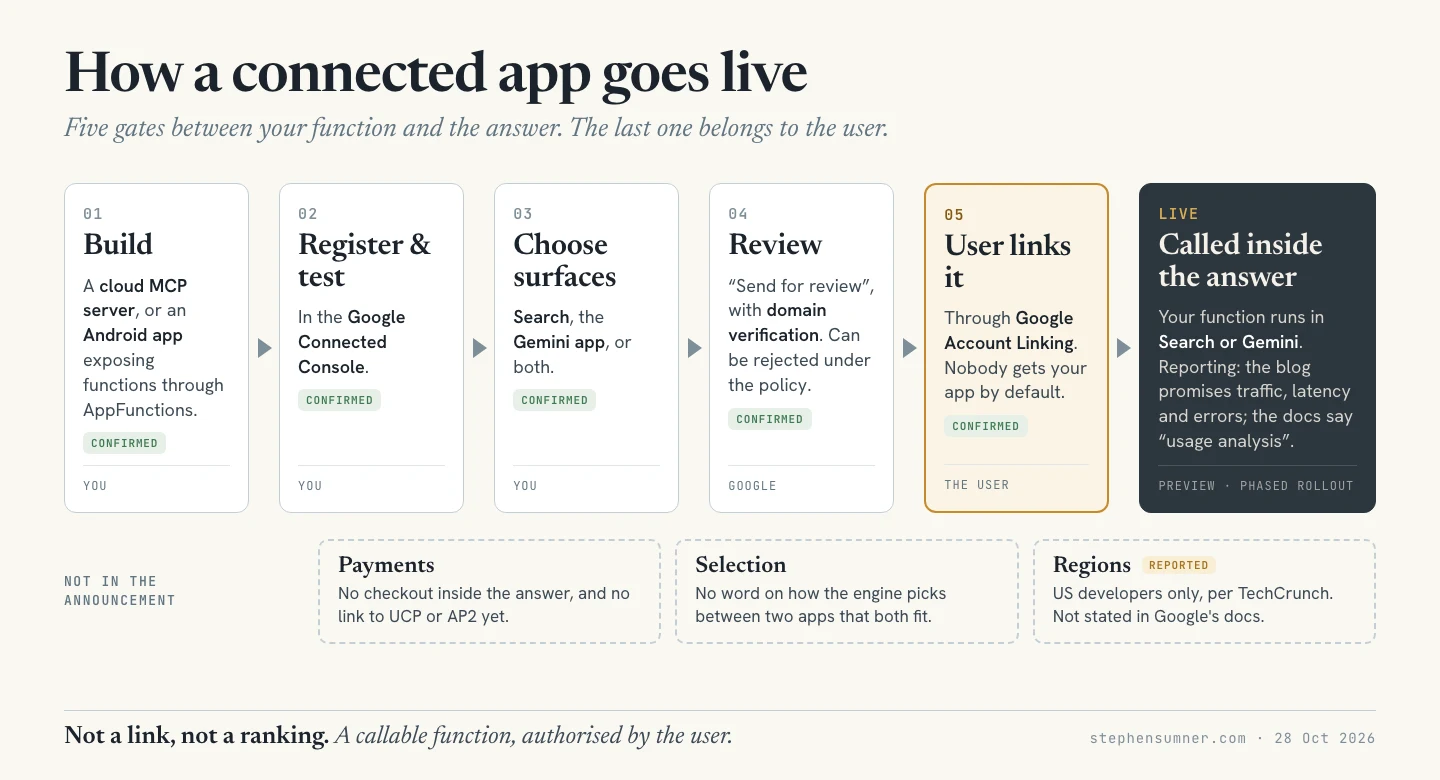
- What it is. The Connected Apps Platform, in preview. It's one place for developers to bring their services into Google Search, the Gemini app, or both. Confirmed (Google blog, 28-10-2026; developers.google.com/connected-apps).
- How you build. There are two routes. A cloud-hosted MCP server uses the Model Context Protocol, the open standard most of the industry has now adopted. Android MCP uses the AppFunctions APIs, so an Android app can expose its functions to Gemini and run them on the device. Confirmed.
- Where you manage it. The Google Connected Console handles registration, testing, submission for review, and choosing which surfaces the app appears on. Confirmed.
- Review is real. Apps go through a "Send for review" step with domain verification, and they can be rejected under a Connected Apps policy. Confirmed (docs).
- Users link apps; Google doesn't hand them out automatically. The docs use Google Account Linking, so the user authorises the connection. 9to5Google reports that in Search, users add apps through their Search settings. Confirmed (account linking) / Reported (Search settings flow).
- Measurement. Google's blog and launch coverage talk about traffic, latency and error-rate reporting. The developer docs themselves only say "usage analysis". Confirmed in the blog, not yet visible in the docs. I'll report back once I've seen the Console.
- Scale. "More than 50" connected apps, including Adobe, Experian and Peloton (live in Gemini, with Search to follow in the coming weeks) and Localiza. Calm is listed as coming, not live. Vendor claim. Many of the 50 already existed as Gemini connected apps and are now being extended to Search. Launch coverage names different partners again (Dropbox, Instacart, OpenTable, Ticketmaster). Reported.
- Who can use it. It's a preview with a phased rollout and a sign-up. TechCrunch reports it's open to US developers only for now. Reported; I couldn't find a region limit in Google's own docs.
What it does not say is just as important.
- Nothing about payments or transactions. None of the Connected Apps material I found mentions taking payment inside the answer, or links the platform to Google's commerce protocols (AP2 and the Universal Commerce Protocol). Those exist, but as separate announcements. The "book and pay inside the answer" picture is where this points, not what launched today. My reading.
- Nothing about ranking. Google hasn't said how Search or Gemini decides which connected app to call when several could answer. That's the question every SEO will ask first, and right now the honest answer is that we don't know.
it's not a link and it's not a ranking. It's a callable function, authorised by the user, living inside the answer engine.
Four eras of search, in one sentence each
I've found this the simplest way to explain the shift to clients.
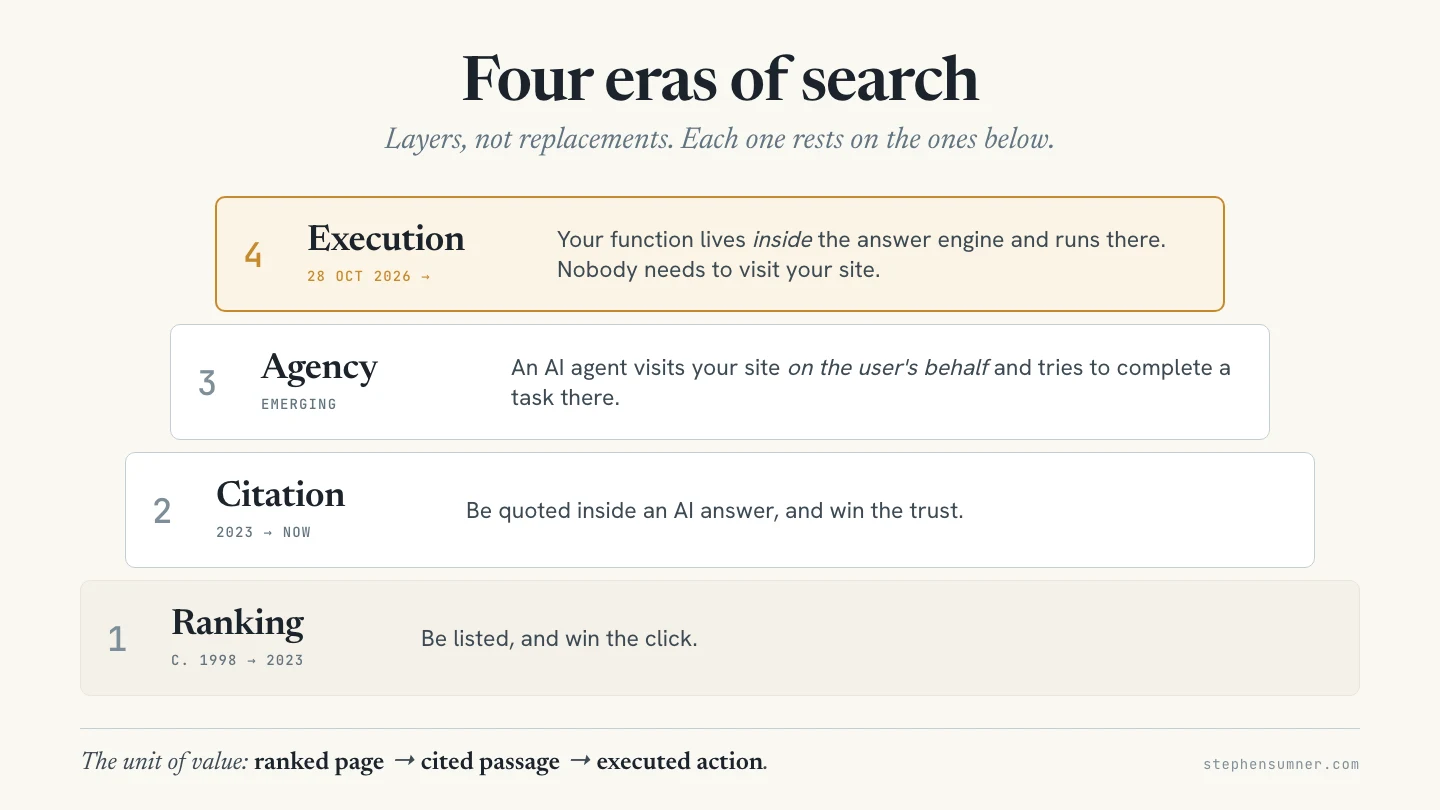
- Ranking (roughly 1998–2023): be listed, and win the click.
- Citation (2023–now): be quoted inside an AI answer, and win the trust.
- Agency (emerging): an AI agent visits your site on the user's behalf and tries to complete a task there.
- Execution (today's announcement): your function lives inside the answer engine and runs there, without anyone needing to visit your site.
The unit of value went from the ranked page, to the cited passage, to the executed action.
The important point is that these are layers, not replacements. Era 4 still depends on eras 1 and 2. An answer engine has to know you exist, trust you, and understand what you do before it will ever call your function. My reading.
It's not just Google: the plumbing everyone is laying
What makes this announcement more than a Google product launch is that it sits on shared infrastructure. Most of the industry is converging on the same pipes.
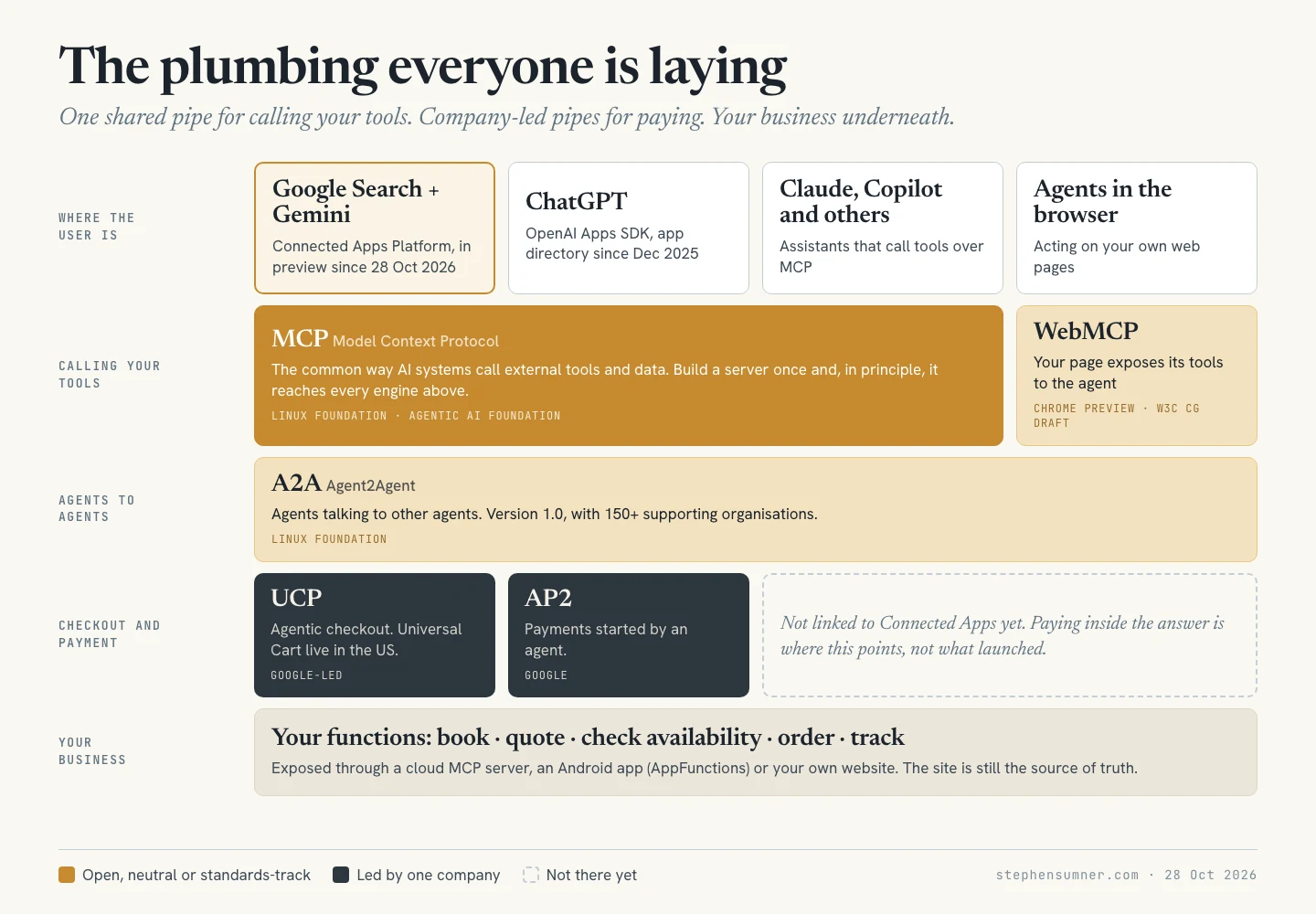
| Layer | What it is | Status |
|---|---|---|
| MCP (Model Context Protocol) | The common way AI systems call external tools and data | Donated by Anthropic to the Linux Foundation's Agentic AI Foundation, 09-12-2025. Anthropic then cited 10,000+ active servers and 97M+ monthly SDK downloads (vendor claim). Current spec dated 28-07-2026. Server counts vary from roughly 7k to 37k depending on whose registry you count. |
| A2A (Agent2Agent) | Agents talking to other agents | v1.0, with 150+ supporting organisations (Linux Foundation, 09-04-2026). |
| UCP (Universal Commerce Protocol) | Google-led agentic checkout | Announced 11-01-2026 with five co-developers and 20+ endorsers. Works alongside A2A, AP2 and MCP. Universal Cart launched in the US on 15-10-2026. |
| AP2 (Agent Payments Protocol) | Payments initiated by agents | Google, 2025. Connected to Gemini Spark (reported). |
| WebMCP | Lets a web page expose its tools to an AI agent in the browser | Early preview in Chrome (10-02-2026). A W3C Community Group draft, not a W3C standard. |
| OpenAI Apps SDK | Apps inside ChatGPT | An app directory opened in December 2025. OpenAI claims 1.2bn weekly ChatGPT users (DevDay, 29-09-2026, vendor claim). OpenAI reportedly scaled back Instant Checkout in March 2026 and moved purchases into retailers' own flows (reported). |
Two things stand out.
MCP has quietly become the shared standard. Google, OpenAI, Microsoft and Anthropic all support it, and it's now under neutral governance. If you build an MCP server once, the same work can, in principle, reach several answer engines. That's the biggest practical difference from the structured-data era, where you optimised mostly for one engine. My reading, but a well-supported one.
Retailers are split down the middle. In March 2026 Amazon won an injunction to stop Perplexity's Comet agent shopping on its site. The Ninth Circuit vacated it on 04-08-2026, essentially because the user directs the agent, and the case continues. Confirmed/Reported. Meanwhile other retailers are signing up to Google's own checkout protocol, which launched with twenty-plus endorsers. Some businesses are fighting agents; others are building them a front door. Expect your clients to have to pick a side.
The giants aren't in great shape either
It's easy to read an announcement like this as an all-powerful Google rearranging the web. The data says something more interesting: the companies building these answer engines are under real financial, legal and regulatory pressure. That bears directly on how much you should bet on any one of them.
Alphabet reported Q3 2026 results on the same day. Confirmed (SEC 8-K) / Reported (Fortune analysis).
- Revenue was $127.6bn, up 25%, with Cloud up 103% to $30.7bn.
- Search & other grew 12%. That's down from 19% in Q1 and 17% in Q2, and below the ~15% analysts expected.
- Capex was $51.4bn in the quarter, and free cash flow was negative, at around -$9.1bn.
- Fortune reports capex guidance of roughly $200bn for 2026, rising to about $300bn in 2027. Reported.
- The shares fell more than 11% after hours.
Read that alongside today's launch. Google's core search money machine is slowing while it spends unprecedented sums on AI. Connected Apps is, among other things, a bid to make the AI answer commercially sticky. My reading.
Market share is not collapsing. For balance: StatCounter still has Google at about 90% of worldwide search (89.94% in September 2026). Anyone telling you Google search is dead is ignoring this.
Clicks are, though. Here's the honest picture on what AI answers do to traffic.
- Pew Research (July 2025, 900 US adults): people clicked a result on 8% of visits that showed an AI summary, against 15% without one. Only 1% clicked a link inside the summary. Confirmed.
- Ahrefs (February 2026, 300k keywords): position-one CTR was 58% below expected where an AI Overview appeared. Vendor study, correlation.
- Seer Interactive (April 2026): organic CTR on queries with an AI Overview fell to 1.31% in December 2025, then recovered to 2.36% by February 2026, against 3.82% without one. Confirmed. The recovery matters, and most people only quote the bad half.
Regulators are now inside the building.
- EU: €890m in Digital Markets Act fines (23-07-2026): €460m for search self-preferencing and €430m for Play. A separate probe into AI Overviews and publisher content is still open. Confirmed.
- UK: On 03-06-2026 the CMA imposed its first conduct requirement on Google Search. Publishers get an opt-out from AI Overviews and AI Mode, with attribution links, and Google has nine months to implement it. Confirmed.
- US search case: Exclusive deals are banned and default deals are limited to one-year terms, but payments to Apple are allowed. Appeals are running and a decision is unlikely before 2027. Confirmed/Reported.
- US ad tech case (September 2026): No forced sale of AdX, but behavioural remedies with six years of oversight. Google will appeal. Reported.
- Penske v Google: For balance, Judge Mehta dismissed Penske's AI Overviews antitrust claim (around 01-10-2026). Reported.
And the others?
- OpenAI. A leaked internal plan (FT, 18-09-2026, unaudited) projects about -$278bn of cumulative free cash flow over 2026–30. The FT later reported annualised revenue nearer $50bn than earlier figures suggested. Ads in ChatGPT started in February 2026. Reported.
- Perplexity. It's fighting several publisher lawsuits, while winning the Amazon appeal. Reported.
- The bubble question. Gartner (14-10-2026) estimates AI data centres need about $8.5tn of revenue through 2030, against at most $3.6tn expected. The BIS finds 55% of AI-firm investment comes from other AI firms. Others, including BofA, call it a normal capital cycle. Analyst opinion, both sides.
The platforms asking you to move your business inside their answers are themselves under financial, legal and regulatory strain. Build for the standard, not the landlord.
The opportunities
- Being the function, not just the source. For businesses with a clear, repeatable action (book, quote, check availability, track an order, get an estimate), being callable inside the answer is a new kind of visibility that competitors may not have yet. Early movers in structured data had a window of a few years. This could be similar. My reading.
- Build once, reach several engines. Because MCP is shared, the same server can potentially serve Gemini, ChatGPT, Claude and Copilot. That makes the investment far easier to justify than a Google-only one. My reading.
- First-party data on AI usage, for the first time. If the Console's traffic, latency and error reporting is what the blog describes, it's the first time an AI surface has given businesses direct data on how their function is used inside the answer. Worth having even if it's thin. Until we see it, this is a promise.
- AI referrals convert. Adobe reports AI-referred retail traffic up 693% year on year over the 2025 holidays, converting 31% better than other traffic. Vendor data. It's from a small base, but the quality signal is clear.
- A new service line for agencies that can bridge strategy and build. MCP servers, account linking, app review and policy compliance sit between SEO, product and engineering. Most businesses have nobody who owns that gap. My reading, and the honest reason I'm writing this.
- Local businesses could leapfrog. A plumber or clinic with a clean booking API could in principle be as callable as a national chain. In practice the booking platforms (OpenTable and the like) will get there first, which is the next section's problem.
The threats
- Platform rent. The aggregators already own the function for many sectors: booking platforms for restaurants, marketplaces for trades, and so on. If they're the connected app, an independent business is one more step removed from its customer, and the toll moves to whoever holds the integration. My reading.
- Brand disintermediation. When the transaction happens inside Gemini, the customer may never see your site, your upsell, your newsletter sign-up or your brand story. You become a service the assistant uses.
- Dependency on a landlord under pressure. See the previous section. Preview programmes change, policies tighten, and Google has retired plenty of developer platforms before. Regulators may also force changes to how these surfaces work, especially in the UK and EU.
- Selection opacity. Nobody yet knows how the engine chooses between two connected apps that can both book a table tonight. Ranking factors took years to reverse-engineer. Selection factors inside an answer may be harder, because there's no results page to observe.
- Security and liability. Prompt injection and tool poisoning are real, documented attack classes; OWASP published a Top 10 for agentic applications in December 2025. OpenAI itself says prompt injection in AI browsers may never be fully solved. Reported. Once your function can act, a manipulated request becomes a business risk, not a content risk.
- Measurement goes dark in a new way. The reporting will be Google's own. Without a results page, independent tools have nothing to scrape. The industry could lose its ability to check the platform's numbers.
- Cost and skills. This is engineering work. Small businesses can't do it themselves, and plenty of agencies will sell it badly. Expect a wave of overpriced "AI app" packages built on thin templates.
What can we imagine? Three scenarios to 2030
These are scenarios, not predictions. I'll revisit them in each update and say which way the evidence is moving.
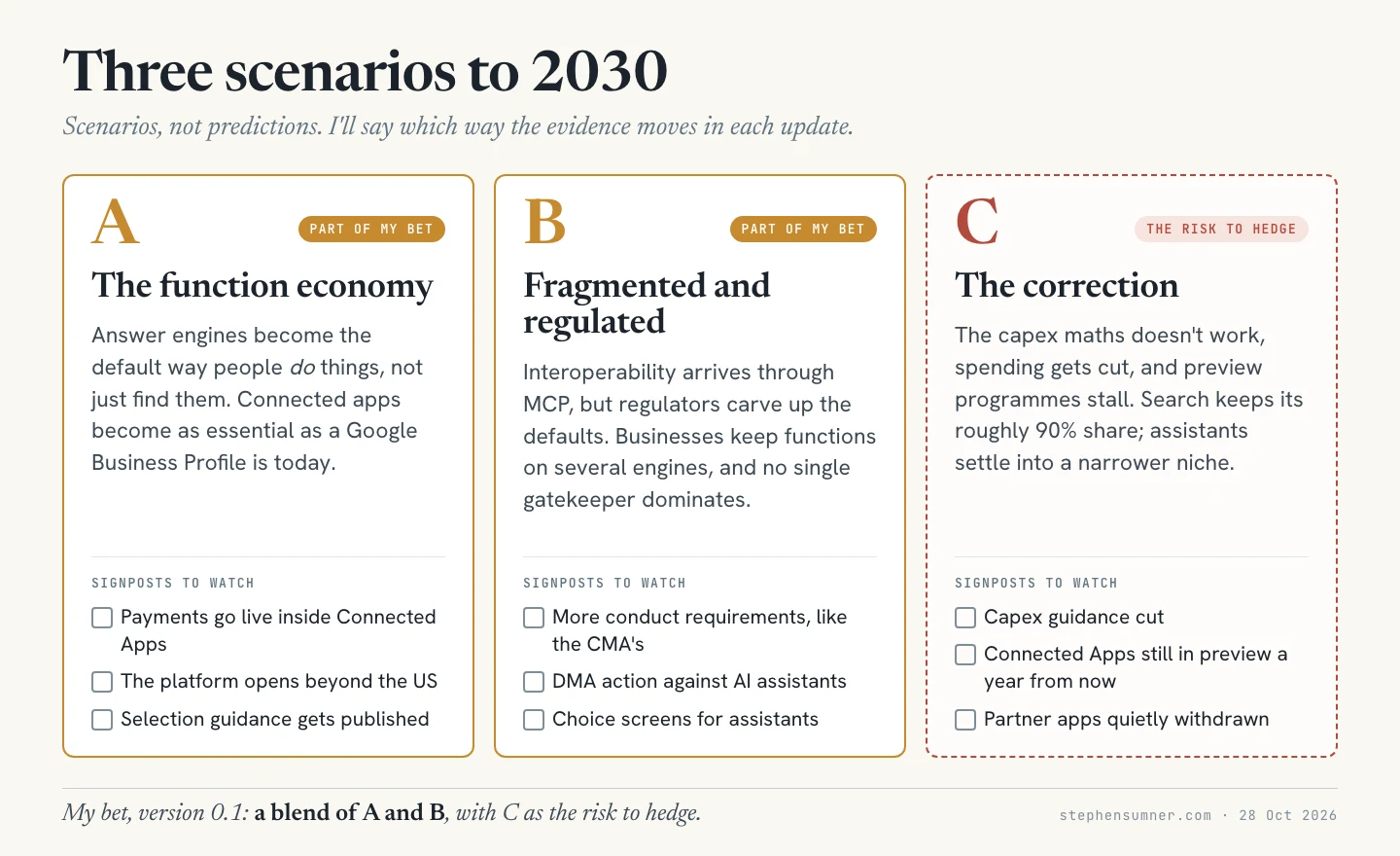
Scenario A: The function economy. Answer engines become the default way people do things, not just find them. Connected apps (Google's, OpenAI's and others') become as essential as a Google Business Profile is today. Agentic commerce lands somewhere in the forecast ranges: McKinsey has $900bn–$1tn in the US and $3–5tn globally by 2030, and Morgan Stanley has $190–385bn in the US by 2030 (Forecasts, with very different scopes). Signposts: payments go live inside Connected Apps, the platform opens beyond the US, and selection guidance gets published.
Scenario B: Fragmented and regulated. Interoperability arrives through MCP, but regulators carve up the defaults. The CMA's opt-outs spread, the EU forces choice screens for assistants, and Apple routes Siri wherever its deals take it. Businesses maintain functions across several engines, and no single gatekeeper dominates. Signposts: more conduct requirements, DMA action against AI assistants, and choice screens.
Scenario C: The correction. The capex maths doesn't work (see Gartner's gap above), spending gets cut, and preview programmes stall or fold quietly. Traditional search keeps its roughly 90% share while assistants settle into a narrower, high-intent niche. The businesses that win are the ones that built for the open standard and didn't over-invest in a single platform. Signposts: capex guidance cut, Connected Apps still in preview a year from now, and partner apps quietly withdrawn.
My honest bet today is a blend of A and B, with C as the risk to hedge. My reading, version 0.1.
Where this leaves some familiar technologies
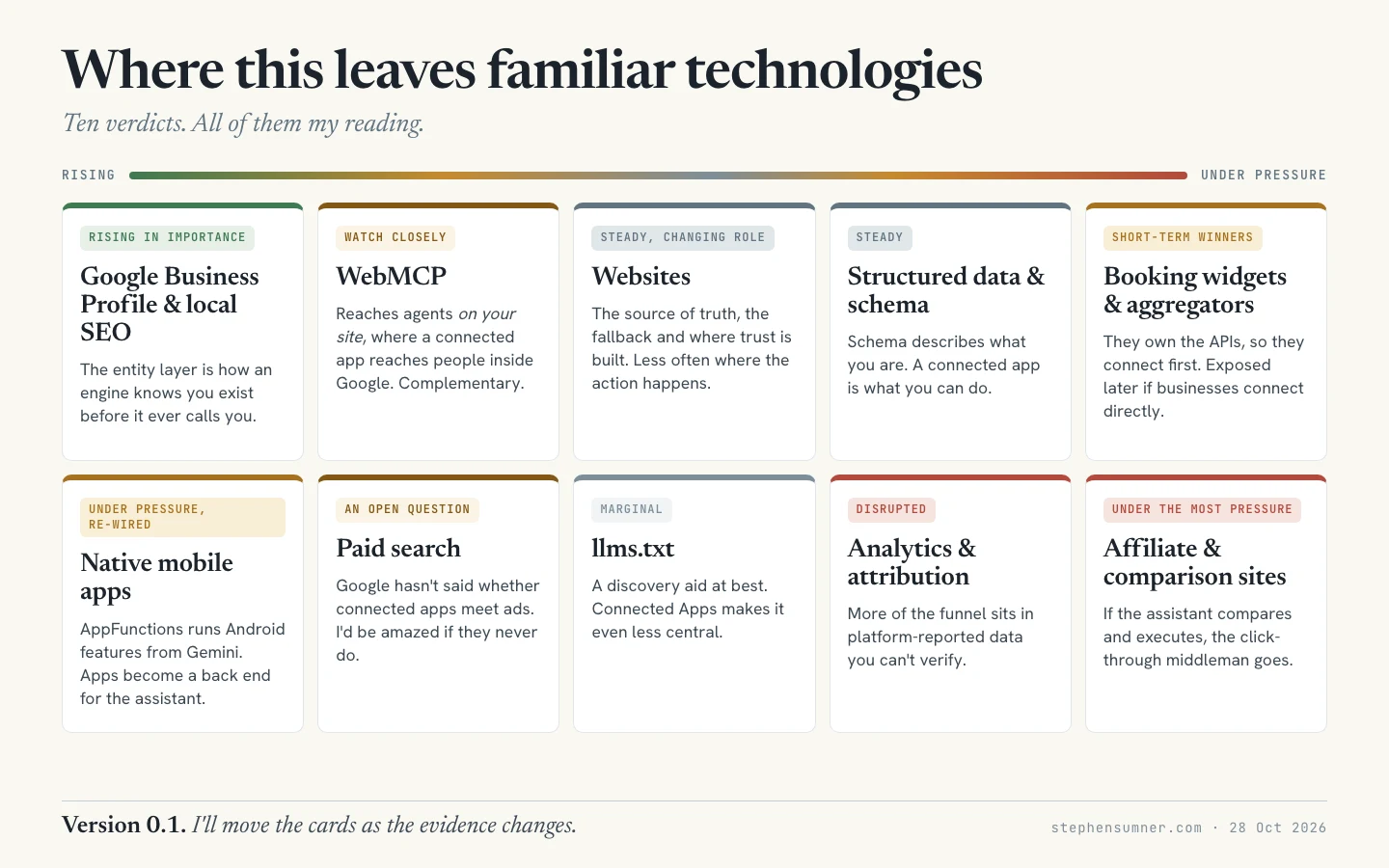
- Websites: Steady, changing role. The website becomes the source of truth and the fallback, plus the place where trust is built. It's still essential, but less often the place where the action happens.
- Structured data / schema: Steady. It still helps engines understand who you are. It doesn't make you callable. Think of schema as describing what you are, and a connected app as what you can do.
- Google Business Profile and local SEO: Rising in importance. The entity layer is how an engine knows you exist before it ever calls your function.
- Booking widgets and aggregators: Short-term winners. They own the APIs, so they'll be connected first. Longer term they're exposed if businesses can connect directly.
- Native mobile apps: Under pressure but re-wired. AppFunctions lets Android apps' features run from Gemini without opening the app. Apps become a back end for the assistant.
- Affiliate and comparison sites: Under the most pressure. If the assistant compares and executes, the click-through middleman is the layer it removes.
- llms.txt: Marginal. My measured view stands. It's a discovery aid at best, and Connected Apps makes it even less central.
- WebMCP: Watch closely. It's the web-native cousin of this: your site exposes its tools to agents in the browser. A Connected App reaches people inside Google; WebMCP reaches agents on your site. They're complementary.
- Analytics and attribution: Disrupted. Expect more of the funnel to sit in platform-reported data you can't independently verify.
- Paid search: An open question. Google hasn't said how, or whether, connected apps interact with ads. Given the revenue numbers above, I'd be amazed if they never do. My reading.
What I'd do now (and what I wouldn't)
Do now (low cost):
- List your functions. What does a customer actually do with you? Book, quote, check, order, ask? Rank them by value.
- Check whether those functions have an API. If they live in a third-party booking system, find out whether that provider is building a connected app, and what it will cost you.
- Keep the foundations clean. Indexability, citation-ready content, a consistent entity across Google Business Profile and schema. Everything in my AI Readiness Framework still applies, and it's what decides whether an engine trusts you enough to call you.
- Get on the list. If you're a US developer or have a US presence, sign up for the preview to see the Console first-hand.
Don't do yet:
- Don't pay anyone thousands for an "AI app" before payments, selection logic and non-US availability are clearer.
- Don't treat this as a reason to cut traditional SEO. The numbers above say search is still the main event.
A word on honest expectations
I'll end the substance where I always do. This does not retire SEO. Google still holds about 90% of search. AI referrals are growing fast but from a small base, and most of the big numbers in this space are forecasts, many of them from people selling the future. What changed today is narrower and more useful to understand: the answer engine can now call a business, not just cite one. That's a new layer on top of everything that still works, and it's worth getting ahead of. It's not worth abandoning the rest for.
I'll keep reporting the same way. Observed is observed, reported is reported, forecasts are forecasts, and my own opinion is labelled as mine.
What I'm watching next (and will update here)
- ☐ Hands-on look at the Connected Console and its actual reporting
- ☐ Any Google guidance on how connected apps are selected in Search and Gemini
- ☐ Payments and checkout inside Connected Apps (UCP/AP2 link-up)
- ☐ Expansion beyond US developers; UK/EU availability and how the CMA/DMA position applies
- ☐ Which aggregators connect first in local sectors (restaurants, trades, health, legal)
- ☐ Building a test connected app myself, as a non-developer, and reporting honestly on the effort
- ☐ Alphabet Q4 numbers: does Search growth keep slowing?
Stephen's out-there thoughts
Right. Everything above is me being careful. This bit is me with a cup of tea, wondering out loud where an open standard for calling functions could take us. None of it is a forecast and none of it is advice. I'd be pleased if one of these came true by 2030. Each one comes with the reason I don't think it's daft. My reading, every word.
- The pub that answers for itself. Instead of an assistant guessing from three-year-old reviews whether the Red Lion does food on a Monday, it just asks the Red Lion. "Table for four at seven? Proper job, that's booked." The landlord never touches a website; the booking system does the talking. Why it's not daft: that's exactly the shape of a connected app, a small function called from inside the answer.
- "Dreckly" becomes an availability status. Once your assistant can talk to the plumber's assistant, which is what agent-to-agent protocols like A2A are for, the two of them will sort out a slot without either human picking up the phone. I fully expect a West Country booking system to reply "dreckly", and the agents to spend some time working out what it means. (It means "at some point". Possibly.) Why it's not daft: agents negotiating with agents is the stated purpose of A2A.
- Tool-description stuffing is the new keyword stuffing. Somebody, somewhere, is already writing an MCP tool description that calls itself "the best, cheapest, most trusted plumber in Somerset", hoping the engine picks it. We've seen this film before, and it ended with Panda and Penguin. Why it's not daft: how engines choose between connected apps is the big unanswered question, and wherever selection is opaque, someone tries to game it.
- The busiest visitor to your website won't be a person. If agents do the visiting and answer engines do the doing, your site's main audience becomes machines checking that what you say is true. We'll write for the agent the way we once wrote for Googlebot, and the Monday report will ask which agents came round, not which people. Why it's not daft: it's the agency era above, carried to its conclusion.
- The parish council becomes a connected app. Bin day, planning objections, whether the harbour car park is free after six. Dull, essential, and exactly the sort of thing nobody wants to click through four pages to find. My money's on a small council getting there before a big one. Why it's not daft: simple lookups are the easiest functions to expose, and the least risky.
- Your assistant gets a "mind how you go" setting. Once functions can act, I want mine to check before it books or pays for anything: "You sure, my lover? That's Bridgwater, not Bridport." Why it's not daft: a human confirming before an agent acts is one of the most practical defences against the prompt-injection risks in the threats section.
I'll come back to these in each update and own up when they start looking daft. Some of them will.
Sources
- Google blog, Connected Apps announcement (28-10-2026): https://blog.google/innovation-and-ai/technology/developers-tools/connected-apps-one-place/
- Google developer docs: https://developers.google.com/connected-apps (plus /mcp, /connected-apps-policy, /gpc/prerequisites)
- TechCrunch (28-10-2026): https://techcrunch.com/2026/10/28/as-ai-agents-reshape-the-web-google-opens-gemini-and-search-to-more-apps/
- 9to5Google (28-10-2026): https://9to5google.com/2026/10/28/gemini-google-connected-apps-platform/
- Alphabet Q3 2026 earnings release (SEC): https://www.sec.gov/Archives/edgar/data/0001652044/000165204426000080/googexhibit991q32026.htm
- Fortune on Alphabet Q3 (28-10-2026): https://fortune.com/2026/10/28/alphabet-google-stock-drops-cloud-revenue-doubles-free-cash-flow-negative/
- StatCounter search share: https://gs.statcounter.com/search-engine-market-share/all/worldwide
- Pew Research (22-07-2025): https://www.pewresearch.org/short-reads/2025/07/22/google-users-are-less-likely-to-click-on-links-when-an-ai-summary-appears-in-the-results/
- Ahrefs (02-2026): https://ahrefs.com/blog/ai-overviews-reduce-clicks-update/
- Seer Interactive (04-2026): https://www.seerinteractive.com/insights/aio-impact-on-google-ctr-2026-update
- EU DMA fines (23-07-2026): https://digital-markets-act.ec.europa.eu/commission-fines-google-eur890-million-breaches-digital-markets-act-2026-07-23_en
- UK CMA conduct requirement (03-06-2026): https://www.gov.uk/government/news/cma-secures-fairer-deal-for-publishers-and-improves-google-search-services-in-uk
- Press Gazette on Penske dismissal: https://pressgazette.co.uk/news/penske-ai-overviews-lawsuit-dismissed-because-no-formal-bargain-struck-with-google/
- Google UCP / agentic commerce: https://blog.google/products/ads-commerce/agentic-commerce-ai-tools-protocol-retailers-platforms/
- Universal Cart: https://blog.google/products-and-platforms/products/shopping/universal-cart-launch/
- WebMCP early preview: https://developer.chrome.com/blog/webmcp-epp
- A2A (Linux Foundation): https://linuxfoundation.org/press/a2a-protocol-surpasses-150-organizations-lands-in-major-cloud-platforms-and-sees-enterprise-production-use-in-first-year
- McKinsey agentic commerce: https://www.mckinsey.com/capabilities/quantumblack/our-insights/the-agentic-commerce-opportunity-how-ai-agents-are-ushering-in-a-new-era-for-consumers-and-merchants
- Adobe holiday projection (via Digital Commerce 360): https://www.digitalcommerce360.com/2026/09/29/adobe-projection-2026-online-holiday-sales-275-billion/
- Fortune on the AI boom/bust debate: https://fortune.com/2026/10/17/ai-boom-vs-bust-bubble-warning-hyperscaler-spending-debt-coreweave-nvidia/
- Microsoft security on agent tool risks: https://www.microsoft.com/en-us/security/blog/2026/06/30/securing-ai-agents-ai-tools-move-from-reading-acting/
- TechCrunch on prompt injection (22-12-2025): https://techcrunch.com/2025/12/22/openai-says-ai-browsers-may-always-be-vulnerable-to-prompt-injection-attacks/

Wondering whether your business should be callable, not just citable?
I'll start where I always do: whether you're eligible to be cited and trusted at all, then whether there's a function worth connecting. Honest answer, including \"not yet\".
Request an audit